

At this time of intensified spiritual warfare, we are presenting a revised, “new” book:
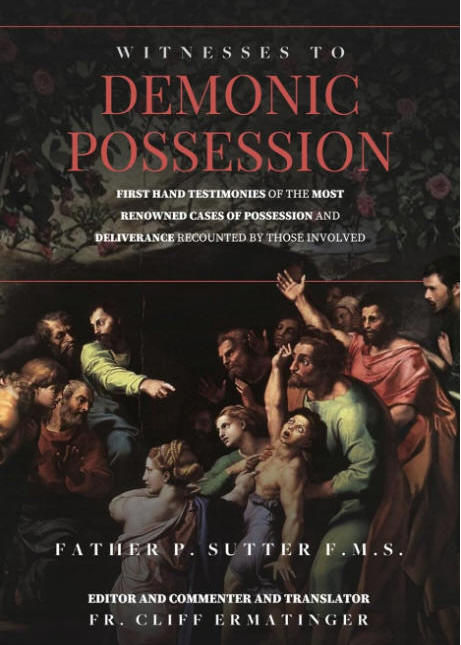
It involves classic cases of possession from (written by Father P. Sutter) years back and now edited by a modern exorcist, Father Cliff Ermatinger, who is primarily based in Milwaukee, where he works full-time as a spiritual consultant and in deliverance ministry, frequently traveling to provide retreats and spiritual direction.
Father Ermatinger also serves as a faculty member and spiritual director for the Pope Leo XIII Institute, which is located at the University of St. Mary of the Lake Seminary in Mundelein, Illinois.
His preface to Witnesses To Demonic Possession, in which he also offers extensive commentary:
“This book was wildly popular when it was first published in 1921. It caught the attention of many and underwent translations into languages reaching double digits. The various revisions over the next decades consisted mostly of including additional data and factoids and similar cases to the ones presented here.
“Of the six published editions, I opted for the third since, after that, it starts to get repetitive, not adding anything new or more illustrative for our purposes.
 “As we shall soon discuss, there are three primary signs of demonic possession that the Church uses to establish the veracity of a case of possession. What’s unique in the cases presented here is that all three signs are almost continuously manifest. This is a rarity and explains why the cases treated here gained such notoriety.
“In 1921, when the subject of demonic possession was relegated almost solely to treatment in theological manuals and the appendices of books on spiritual theology for seminary formation, this book was received as a shocker. A present-day reading reveals a deficit, however.
“After going over it several times to determine if it might be a candidate for a Padre Pio Press translation and publication, it became clear that, in its original form and as a simple translation from German to English, it simply wasn’t satisfactory.
“The well-intentioned author’s goal was to awaken people to the reality of demonic possession — something he excelled at. Yet, with the recent glut of videos and books on the subject, and the new phenomenon of exorcists giving public conferences and interviews, for better or for worse, it’s clear that much of the original book’s contents had already entered into common parlance.
“Further, only discussing the externals of the phenomenon, as Father Sutter does, runs the risk of simply fomenting morbid curiosity or turning the tragic story of the people involved into a circus sideshow. What was lacking in the original was a theological underpinning and an explanation of much that took place.
“To ameliorate this, I have sought to include a running commentary in the footnotes along the way to supply such explanations, as well as a simple but systematic theological introduction to the entire phenomenon, so that the reader might approach the book better equipped.”
An excerpt from one case:
“From September 25, 1865 onward, entirely abnormal phenomena appeared in the boys. Lying on their backs, they spun around with eerie speed like a top. Then they began to pound the bed frames and other furniture with tremendous force and endurance — what they called “threshing” — without feeling the slightest fatigue, no matter how long it lasted. Afterward they would fall again into convulsions and spasms, and then into such depression that they lay motionless for hours, as if lifeless.
“At times the sick boys were seized by a kind of ravenous hunger that nothing could satisfy. Their abdomens would swell greatly, and they felt as though something like a ball were rolling about in their stomachs or moving up and down like a living creature. Their legs would often twist together like corkscrews, and no one could pull them apart.
“The older boy, Theobald, was especially tormented by a distressing being that had a duck’s bill, clawed hands, and a body covered with filthy feathers. Whenever the boy saw this creature hovering above his bed, he cried out in terror, for the apparition threatened to strangle him. He would then rush at it and tear out its feathers — at least…
That book is now here.