It’s a question rarely asked. When it is, it is often quickly answered in the negative.
No. Only demons can. On this, many exorcists agree.
Yet two things stand out.
First is what seems like the differentiation in Scripture between “demons” and “unclean spirits.”
Perhaps these were used synonymously. But also, perhaps not. A demon is certainly “dirty”—filthy. But the notion of cleanliness also brings to mind imperfect humans. Look at the very word “purgatory”: It comes from the Latin purgare, built on roots that mean “cleansing” or “purifying.”
Secondly, there is the classic exorcism case in 1928 in Earling, Iowa.

That involved a woman named Emma Schmidt (referred to in church reports under the alias “Anna Ecklund”) who required a documented, twenty-three-day exorcism at a Franciscan convent spearheaded by a Capuchin friar named Father Theophilus Riesinger and a local pastor, Father Joseph Steiger.
Having suffered afflictions since age 14—including an inability to enter churches or stand near Holy Water, despite medical evaluation declaring her mentally normal—her case escalated until church authorities intervened.
Witnesses recorded levitation, survival on a single teaspoon of milk daily, xenoglossy (understanding and speaking Latin without prior training), and supernatural foresight, such as knowing about Father Steiger’s sudden car crash before he returned to tell anyone.
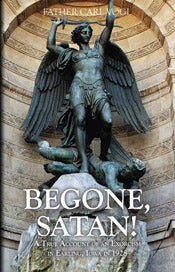
The transcript of the exorcism, contained in the booklet Begone Satan!, mentions that the woman spoke in the voice or with the bestial sounds of many spirits, one identified as Beelzebub, prince of devils.
But in the cacophony of voices was another identified as “Judas Iscariot.”
Judas is the one who of course betrayed Jesus.
He was a deceased human.
According to the detailed account, another spirit that possessed the girl was named Jacob—and was the girl’s own father. “Later developments disclosed the fact that he had a frightfully coarse and brutal life,” says the account.
As the prayers of exorcism continued, a high-pitched, almost falsetto voice was noticed among the legion and confessed that her name was Mina—the father’s mistress who had killed four children.
Beelzebub, Judas, her father Jacob, and “Aunt” Mina were identified as the spirits behind this extraordinary case. Three of the four most prominent spirits had been humans. Were devils merely mimicking them, or does this seminal case teach us something not commonly accepted?
The account states that the exorcism officially ended on December 23, 1928, after a final violent ritual, allowing Emma to live quietly until her death in 1941 (though another published account claimed the exorcisms actually continued for six more years, leaving the truth of the event actively debated).
That spirits of the deceased infest humans is also claimed by a Polish psychotherapist and self-styled, controversial “exorcist” named Wanda Pratnicka, who ministered to thousands of afflicted and wrote a book called Possessed By Ghosts. She claims spirits of the deceased can cause the same illnesses they suffered and convey addictions or sinful proclivities, including theft, promiscuity, and homosexuality. She says the reason many exorcisms fail is that they do not address spirits of the deceased that literally may be haunting and afflicting the living.
Praying away such potential causes may be needed as well as casting out demons, is the assertion (for your discernment).
While true that demons may mimic humans, she cites dozens of instances that imply an additional root cause. “A ghost which has decided not to pass through to the other side of death’s curtain will most often return to its family which it has recently left,” claimed the psychotherapist.
During the famous 67 Catholic exorcism rites performed on Anneliese Michel (known in a movie as “Emily Rose”) between 1975 and 1976, the priests claimed that six distinct entities inhabited her body. Under traditional Catholic theology, these entities were identified as demonic spirits rather than human ghosts, though several took the names and personas of notable historical, biblical, and deceased individuals, including again Judas and also Hitler.
[resource: Begone Satan!]