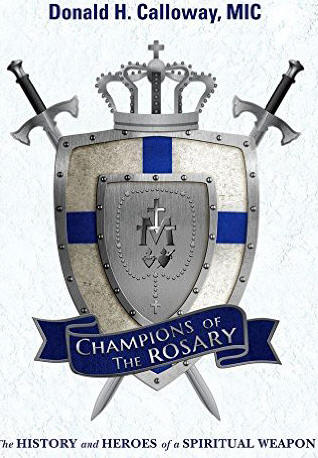
As all attentive Catholics know, throughout the centuries, saints of various (often soaring) stature have spoken of the Rosary, not merely as a prayer, but as a force—a spiritual instrument fashioned by Heaven for times of darkness, confusion, and assault on the soul.
Sounds custom-made for our current topography.
Those saints called it many things, including a “weapon,” a “ladder,” a “school,” and even a “lifeline.” We’ll get into its fascinating history later this week.
They knew that “power” was the Holy Spirit, Who imbues the Rosary with the sure sign of His peace.
The saints? They spoke from experience.
In moments of spiritual battle—when temptation rages, when the Church is shaken, when evil seems emboldened—saints again and again pointed to the famous, Bible-based prayer.
Padre Pio called it plainly “the weapon for these times.” Not a symbol. A weapon.
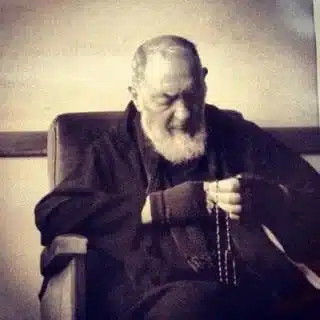
He is said to have prayed at least thirty rosaries (sometimes the fifteen-decade one) a day. He kept a rosary in his hands or pockets, praying it everywhere—in his cell, hallways, stairs.
Did he not exhibit the miraculous?
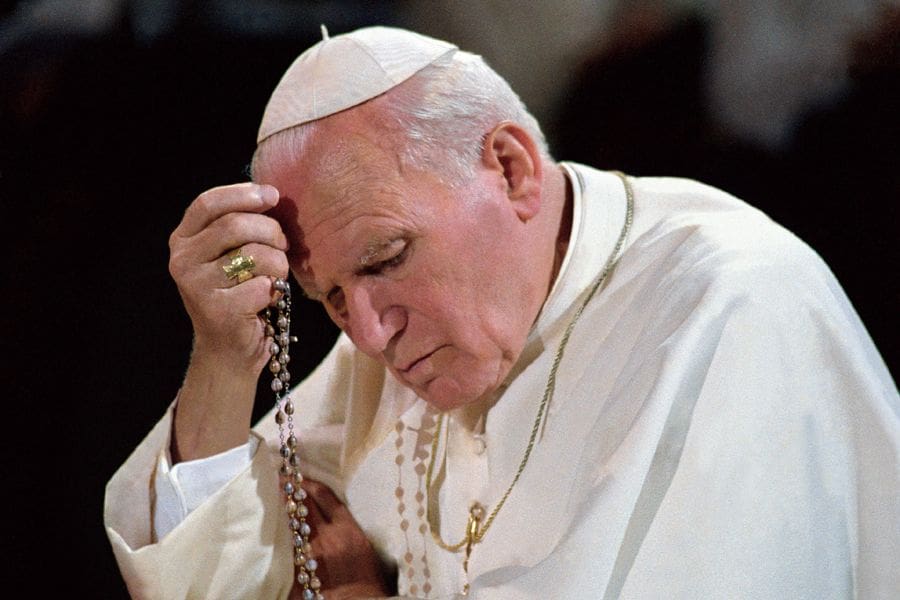
Pope Saint John Paul II held rosary beads up to a crowd in Fulda, Germany, in 1980 and intoned, “Here is the remedy against the evil! Pray, pray, and ask for nothing else. Put everything in the hands of the Mother of God.” Likewise did Josemaría Escrivá proclaim, “The Holy Rosary is a powerful weapon. Use it with confidence and you will be amazed at the results.”
Pope Pius X—who as Supreme Pontiff (1903 to 1914) confronted a fractured society and a weakening of Christian life as well as an incipient world war—consistently promoted the family Rosary as a remedy for unrest, division, and loss of faith, calling it one of the richest sources of Grace available to the faithful.
Was it not another Pius (V) who attributed victory at the Battle of Lepanto specifically to the Rosary, which is where the “weapon” terminology truly solidified in the Church?
According to tradition, Saint Dominic viewed the Rosary as a powerful tool for conversion and spiritual warfare, reportedly receiving it from the Virgin Mary in 1208 in France to combat heresy. He described it as a vital, simple, and effective method of prayer, proclaiming that “one day, through the Rosary and the Scapular, Our Lady will save the world.”
A modern saint, Carlo Acutis, young apostle of the Eucharist, never went a day without praying the Rosary. For him, it was the simplest and most powerful way to stay close to Jesus through Mary.
But perhaps no saint spoke more bluntly than Saint Louis de Montfort, who wrote words that still unsettle: “Never will anyone who says his Rosary every day be led astray by the devil. This is a statement which I would sign with my blood.”
That is not poetry.
That is spiritual warfare.
Again and again, saints testified that when everything else failed—arguments, preaching, speeches, persuasion—the Rosary is what still worked.
The repetition does not dull the soul; it wears down demonic resistance.
Though Marian in form, the Rosary has always been understood as Christ-centered. Saint Charles Borromeo? He treated the Rosary as essential during the Counter-Reformation, promoting it as a means of renewing a Church under siege from error and moral collapse.
For saints who struggled with mental prayer, the Rosary became an anchor. Did not Our Lady appear with one at Fátima?
Francis de Sales tirelessly recommended it as a simple path into deep prayer.
Teresa of Ávila, who candidly admitted difficulties with concentration, relied on structured prayer to keep her soul fixed on Jesus.
And Fulton Sheen captured its mystery with his trademark eloquence when he commented that “the Rosary is the book of the blind, where souls see and enact the greatest drama of love the world has ever known… the book of the aged, whose eyes close upon the shadow of this world and open on the substance of the next.”
The saints did not cling to the Rosary because it’s easy.
They clung to it because it works.
In ages of war, heresy, moral collapse, and confusion—ages not unlike our own—the Rosary endured as a cord binding Heaven to earth.
A chain Satan fears.
A ladder sinners climb.
A weapon the humble still wield, transformed, with those beads, from victims to victors.
[resources: check our book store for more than forty books on the Rosary]