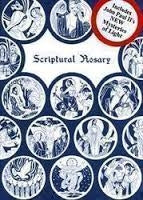
From the powerhouse booklet, Scriptural Rosary:
Most historians trace the origin of the Rosary as we know it today back to the so-called Dark Ages of ninth century Ireland. In those days, as is still true today, the 150 Psalms of David were one of the most important forms of monastic prayer. Monks recited or chanted the Psalms day-after-day as a major source of inspiration.
The lay people who lived near the monasteries could see the beauty of this devotion but because very few people outside the monasteries knew how to read those days, and because the 150 Psalms are too long to memorize, the lay people were unable to adapt this prayer form for their own use.
So one day in about the year 800 A.D., one of the Irish monks suggested to the neighboring lay people that they might like to pray a series of the 150 Our Fathers in place of the 150 Psalms. Little did he know that his simple suggestion was the first step in the development of what would one day become the most popular non-liturgical prayer form of Christianity.
At first, in order to count their 150 Our Fathers, people carried around leather pouches which held 150 or 50 knots, and eventually they began to use strings with 50 pieces of wood.
Shortly afterwards the clergy and lay people in other parts of Europe began to recite, as a repetitive prayer, the Angelic Salutation, which makes up most of the first part of our Hail Mary. Saint Peter Damian, who died in 1072, was the first to mention this prayer form. Soon many people were praying the fifty Angelic Salutations while others favored the fifty Our Fathers.
Origins of the Mysteries
Then during the thirteenth century another prayer form, which would soon give the Rosary its Mysteries,began to develop. Many medieval theologians had long considered the 150 Psalms to be veiled prophecies about the life, death, and resurrection of Jesus. By deep meditation and skillful interpretation of the Psalms certain of these men began to compose ‘Psalters of Our Lord and Savior Jesus Christ.’
Soon ‘psalters’ devoted to 150 praises to Mary were also composed. When a psalter of Marian praises numbered 50 instead of 150, it was commonly called a ‘rosarium’ of bouquet.
Thus, during the thirteenth century there were four distinct “psalters” in use at the same time: the 150 Our Fathers, the 150 Angelic Salutations, the 150 praises of Jesus, and the 150 praises of Mary.
In an age when unity was held in such regard, perhaps it was inevitable that these four prayer forms should eventually be combined.
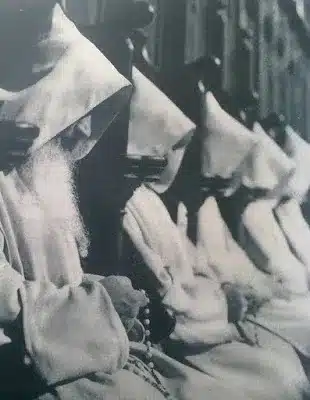
The Carthusians Combine Prayers and Mysteries
The first step toward the combination of these different kinds of psalters came in about 1365 A.D., when Henry of Kalkar, the Visitor of the Carthusian Order, grouped the 150 Angelic Salutations into decades and placed an Our Father before each decade. This combined the Our Father and the Hail Mary for the first time.
Next, in about 1409, another Carthusian, Dominic the Prussian, wrote a book which attached a psalter of fifty thoughts about the lives of Jesus and Mary to a Rosary of fifty Hail Marys. This was the first time that a special thought was ever provided for each Hail Mary bead.
Eventually, the fifty Hail Mary thoughts of Dominic the Prussian were divided, as Henry of Kalkar had done, into groups of ten, with an Our Father in between. Many variations of this form were composed between about 1425 and 1470, but the changes were gradual, not sudden.
The Dominicans Popularize the Special Hail Mary Thoughts
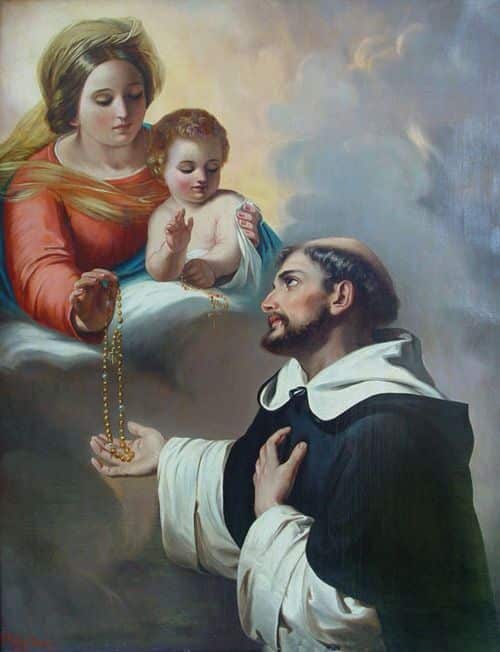
By 1470, when the Dominican Alan of Rupe founded the first Rosary Confraternity—and thereby launched the Dominican Order as the foremost missionaries of the Rosary—he could refer to the Rosary with a special thought for each Hail Mary bead (which was the form he favored) as the “new” Rosary. He referred to the form consisting of Hail Marys with no accompanying statements as the “old” Rosary.
Through the efforts of Alan of Rupe and the early Dominicans, this prayer form—150 Hail Marys with a special thought for each bead—spread rapidly throughout Western Christendom.
It is important to note that this form of Rosary—the form which Alan of Rupe promoted so successfully as the Rosary of Saint Dominic—is the model upon which the new Scriptural Rosary is based; that is, a Rosary with a special thought for each of the Hail Mary beads.
[SD note: Through the years—since the mid-1980s—we have found this to be a real powerhouse: not just fifteen decades but also reading Scripture every day, a great way to begin the morning. With it we are saying: Not today, Satan.]
[resources: the Scriptural Rosary]