

It doesn’t get more worldly than what they call the “elites.”
These are the billionaires and celebrities and “stars,” what used to be called Hollywood idols.
An interesting word, that: “idol.”
In our time, there are many venues for the elite, many of them secretives.
Few are more so than the notorious “Bilderbergers,” who meet annually to discuss politics, finance (mammon), business, academia, media, and cultural trends.
What the Bilderberg Group entails is a private, invitation-only annual conference that began in 1954. It was created to encourage informal discussion between influential people from Europe and North America. The name comes from the Hotel de Bilderberg in the Netherlands, where the first meeting was held.

In practical terms, it is an elite networking and discussion forum, not a public organization with members you can elect or meetings you can watch. The organizers say the purpose is dialogue, not decision-making, and that participants speak under rules that allow ideas to be discussed privately without public attribution. Official descriptions say there are typically about 120–140 attendees each year, with roughly two-thirds from Europe and the rest from North America.
Why people talk about it so much is the secrecy.
Meetings are closed to the press, there is limited transparency, and many very powerful people attend.
Because of that, the group has long attracted claims that it secretly shapes world events. Reuters and other mainstream coverage note that the secrecy has fueled conspiracy theories, while experts generally describe it as influential but not literally a hidden world government.
That makes it easy for many believers to connect it with biblical warnings about the “kings of the earth,” global commerce, deception, and end-times consolidation of power in passages such as Revelation 13, 17, and 18.
The official 2026 list appears to contain about 128 participants from 23 countries and territories.
The secrecy is certainly not total. The most current official list is for the 72nd Bilderberg Meeting, held April 9–12, 2026, in Washington, D.C., included Demis Hassabis, co-founder and CEO of Google DeepMind, Alex Karp, CEO of Palantir, Jack Clark, co-founder of Anthropic, a representative from Microsoft, and Arthur Mensch, CEO of Mistral A.I.
Note the rising tide of technocrats and the capacity they have for the collection of global data and personal information.
Though a representative was there, absent this year was Peter Thiel, who founded Palantir, a software company that helps governments and large organizations combine data (including personal stuff), analyze it, and use it to make operational decisions. Its own description says its software powers real-time, AI-driven decisions for government and commercial customers.
From a prophetic viewpoint, Palantir can look like a sign of the kind of system many believers fear: a world in which vast amounts of information are centralized, analyzed, and used to guide behavior, policing, war, finance, and public life from the top down. Palantir itself says its software powers “real-time, A.I.-driven decisions” in critical government and commercial settings, and that its AIP platform connects A.I. directly to an organization’s data and operations.
That’s Big Brotherish—at the least, providing the infrastructure for a one-world ruler. Critics worry about privacy, due process, surveillance, and state power.
Missing this year, ironically, was Palantir’s founder, Peter Thiel, who has been traipsing around the world giving highly private lectures on the notion of “anti-christ.”
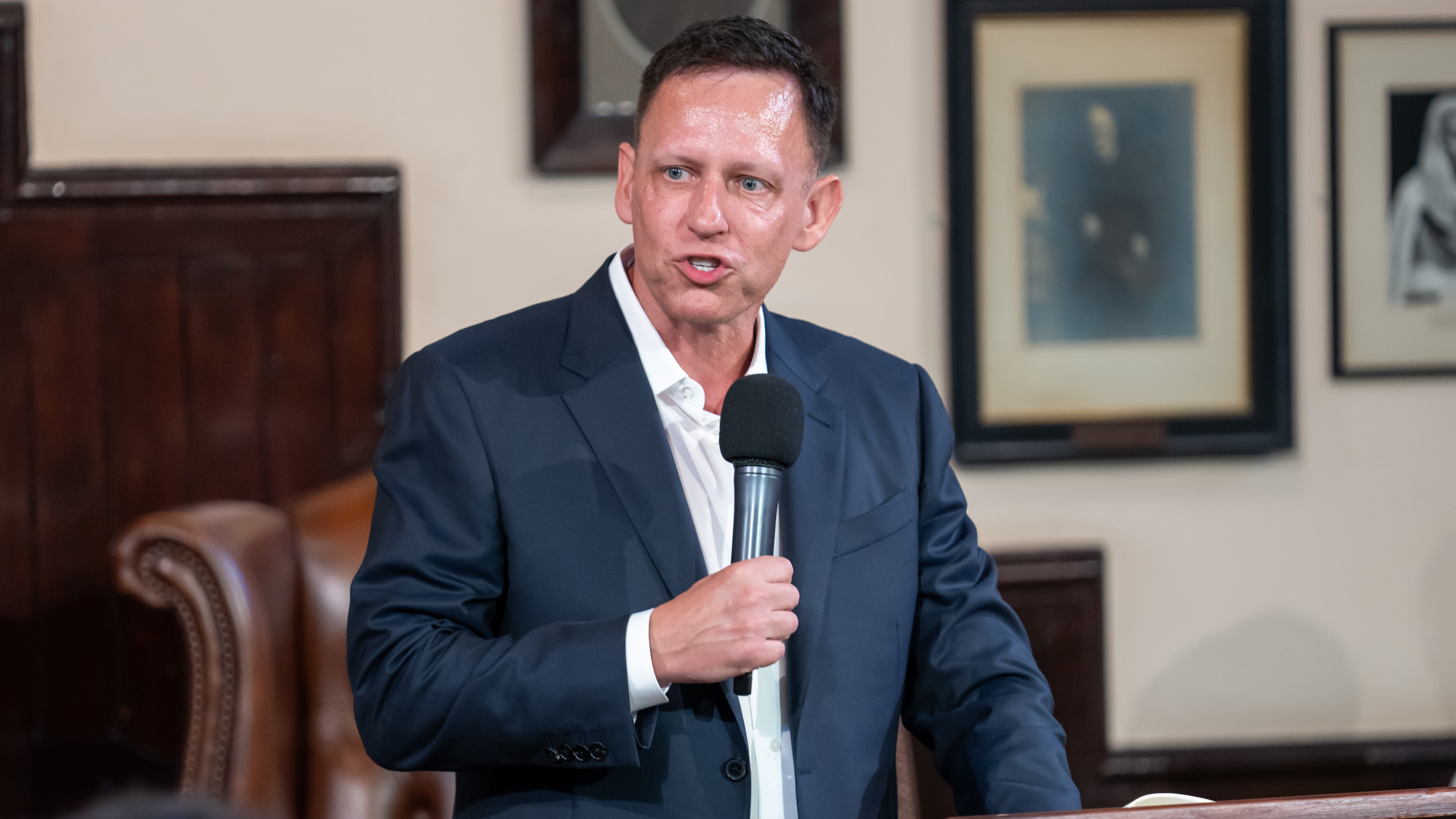
That sounds a bit counter-intuitive here, if not suspicious.