


The papacy of Pope Leo XIV has recently been marked by a resurfaced (or depending on your view, might the word be “contrived”) controversy involving the Andean figure of Pachamama, drawing immediate and polarized comparisons to the 2019 Pachamama “scandal” under his predecessor, Pope Francis.
While both events involve the same cultural symbol, the context of each—and the Vatican’s response—highlights a shift in how the Church navigates the line between indigenous inculturation and doctrinal purity.
The current controversy surrounding Pope Leo XIV centers on a photograph from 1995, long before his election to the papacy. At the time, the future Pope was Father Robert Prevost, an Augustinian missionary serving in Peru. The image, which surfaced in early 2026, depicts him kneeling during an “Eco-theology” colloquium in Brazil.
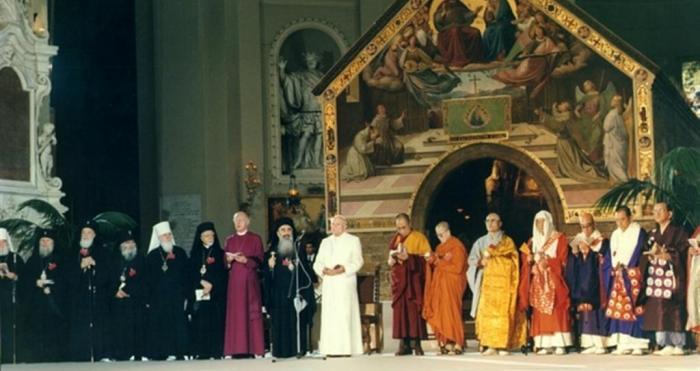
Those who dismiss the controversies (which have served as blog and YouTube “clickbait”) note that Pope John Paul II, now a saint, was widely criticized for participating in cross-cultural (including Buddhist and Hindu) events in Assisi, Italy, and a voodoo-like ceremony in Africa.
He also was “blessed” in an Indian rite in 2002 in the Cathedral of Our Lady of Guadalupe.
/114_ZapotecBlessing01.jpg)
/171_JPII-VoodooHighPriest.jpg)
Wooden statues representing the Andean fertility figure Pachamama (or “Mother Earth”) were brought into Vatican-related spaces, including a church and St. Peter’s Basilica, during the 2019 Amazon Synod, culminating with a bowl from the rituals being placed on an altar by Pope Francis.
This was clearly a bridge too far and a mistake.
The statues were thus used in a garden ceremony attended by the Pope, displayed in the Church of Santa Maria in Traspontina, and carried in a procession to the Synod Hall.
As for Pope Leo XIV, who is far less a lightning rod, critics argue the caption in the original 1996 publication explicitly identifies the event as a “Celebration of the Pachamama Rite.” Opponents of the Pope claim that kneeling in such a context constitutes an act of adoration toward a pagan deity. Conversely, defenders argue that the gesture was a sign of respect for the “soul of the earth” as a creature of God, rather than a religious act of worship. They maintain that for missionaries in the Andes, Pachamama is often viewed as a cultural metaphor for Mother Nature rather than a literal goddess.
The Assisi gathering on October 27, 1986, was intended by John Paul II as a World Day of Prayer for Peace, bringing together Christian leaders and representatives of other religions. The Pope’s defenders stressed that the participants did not merge their religions into one act of worship, but rather came together in a common setting while praying according to their own traditions for peace. Even so, the event became highly controversial because many Catholics felt that the public symbolism created the impression of syncretism. Images from Assisi—especially non-Christian rites taking place in Catholic spaces—convinced critics that the papacy had crossed a line, even if John Paul himself presented the day as a witness to peace, not a denial of Catholic truth.
A related concern arose in France at Taizé, the ecumenical Protestant-founded community John Paul II visited on October 5, 1986. To admirers, Taizé represented a sincere search for Christian unity and reconciliation. To critics, however, such appearances encouraged confusion about the differences between Catholicism and Protestantism, especially in an era when many already believed doctrine was being softened in favor of goodwill and symbolism. John Paul praised Taizé warmly, which delighted ecumenists but alarmed those who feared that visible fraternity was being emphasized more than the hard work of doctrinal clarity.
The Africa controversy is often described even more dramatically than the facts support. During his February 4, 1993, trip to Benin, John Paul II met with representatives of Vodun, often called voodoo in English. That meeting was real, and it did provoke criticism. But the strongest claims—that the Pope personally took part in a voodoo rite as an act of worship—go beyond what the main contemporary reporting and Vatican records establish. The controversy instead centered on his willingness to meet Vodun representatives respectfully and to speak about elements in traditional religion that could be points of contact for evangelization. For some Catholics, that approach looked like diplomacy and missionary openness; for others, it looked like dangerous accommodation with a religion associated in the popular imagination with occultism and spirit practices.
In the end, the disputes over Assisi, Taizé, the Vatican Garden, and Benin were really disputes over the post-Vatican II direction of the Church. John Paul II believed the Church could enter dialogue without surrendering her identity. His critics worried that public gestures can teach as powerfully as formal doctrine, and that even well-meant encounters may scandalize the faithful when they appear to place Christianity on the same level as other religions. That is why these episodes remain flashpoints to this day: they touch the deepest Catholic questions about truth, mission, and how far a Pope should go in trying to build bridges with the religious world.