Call it a “clear and present danger,” like the famous novel by that title, or more accurately, “a clear and increasingly present peril.”
One refers here to the striking and frequently startling presence, and of late, nearly omnipresence, of Islam.
The most obvious dangers are in Africa—where Christians and especially Catholics are being slaughtered by Muslim terrorists in countries such as Nigeria. According to the Catholic Bishops’ Conference of Nigeria, at least 145 priests have been abducted and eleven murdered since 2015.
Independent watchdog groups place those numbers much higher, reporting that over 250 Catholic clergy members have faced direct violent ambushes or kidnappings by a combination of jihadist groups (like ISWAP and Boko Haram) and heavily armed criminal syndicates operating for financial ransom.
During coordinated attacks in late 2024, Islamist militants systematically burned down eight Catholic churches belonging to St. Mary’s Parish in the Gboko Diocese, along with the local rectory, schools, and clinics. Over the past decade, that single diocese has seen more than thirty-two churches destroyed.
The tracking group Intersociety estimates that roughly 1,200 Christian churches across all denominations are attacked, damaged, or destroyed annually in Nigeria.
It’s not just Muslims; Christians increasingly are under attack in Israel, Gaza, and Lebanon by Jews. To be objective, surprising it is that through the centuries, Muslims in the Holy Land have been more protective of Christian sites than have Jews.
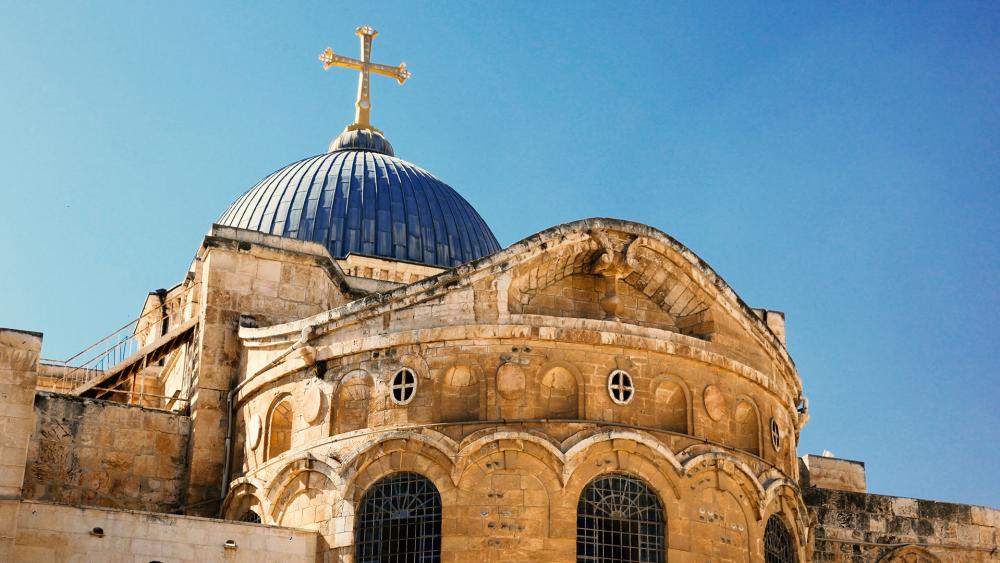
Three times over the course of history, Muslims repaired the roof or rebuilt parts of the Holy Sepulchre, while currently that great, holiest of churches is in a state of disrepair.
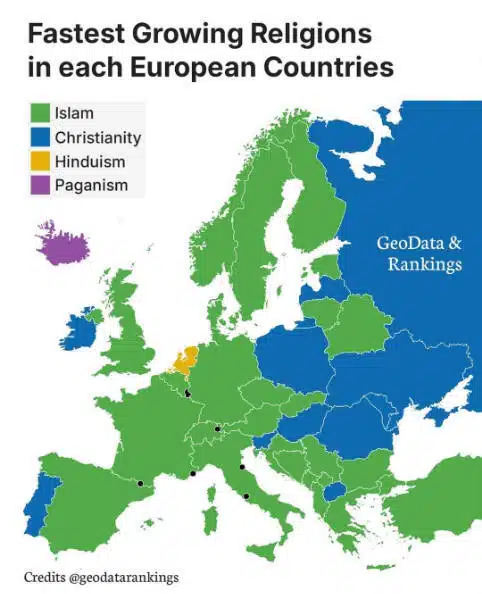
But Muslims are creating the bigger issue globally and have been increasingly asserting themselves in—some fear “invading”—Europe and North America.
Up in Belfast, Northern Ireland, in June, a recent Muslim refugee from Sudan brutally stabbed a local man in the face and head. The number of Muslims in the United Kingdom has grown between the 2011 and 2021 censuses by approximately 1.2 million.
The problem is that many of them believe they’re on a mission to supplant if not eliminate Christianity, and some reportedly intentionally set about raising large families in that demographic cause.
Looking across the full span of the past ten years, total Muslim immigration to Western Europe—encompassing asylum seekers, family reunifications, and regular migration for work or education—is estimated to be between four million and five million people. As a result of these sustained trends, Muslims currently account for roughly 18 percent of the total foreign-born migrant population residing in Europe.
While Europe sees thousands of anti-Christian hate crimes annually, only a fraction are committed by Islamic extremists; the vast majority are carried out by secular, political, anarchist, criminal, or mentally disturbed individuals.
According to data compiled by the Vienna-based Observatory on Intolerance and Discrimination Against Christians in Europe (OIDAC), over 2,200 anti-Christian hate crimes were documented across Europe in 2024 alone.
Arson attacks nearly doubled in Europe, with 94 confirmed cases recorded in 2024.
And a notable incident occurred in September 2024, when the historic Catholic Church of the Immaculate Conception in Saint-Omer, France, was nearly destroyed by a massive fire.
Germany also experienced a sharp spike, accounting for roughly a third of all European church arsons.
While explicit Islamic extremist attacks are not common, notable instances include a January 2024 ISIS-linked shooting during Sunday Mass at a Catholic church in Istanbul, Turkey, which left one person dead, and a 2023 machete attack by a jihadist radical in Algeciras, Spain, that killed a Catholic altar server and injured a priest. Indonesia, India, and other parts of Asia have suffered Islamic assaults.
Unlike the situation in Africa, there are virtually no documented cases in recent years of Islamic extremists damaging or destroying Catholic churches in the United States. Instead, the perpetrators and motivations behind American church attacks generally fall into a few distinct, domestic categories.
Still, there is an ongoing persecution: the U.S. Catholic Conference of Bishops has tracked more than 370 distinct attacks directly targeting Catholic churches since 2020.
These primarily consist of the desecration of sacred symbols, such as spray-painting or decapitating statues of the Blessed Virgin Mary and Jesus, turning altar Crosses upside down, or smashing historic stained-glass windows.
A large percentage of the recorded vandalism (which accounts for the vast majority of church incidents) is driven by apolitical, secular property crimes. This includes teenagers engaging in destructive behavior, vagrancy-related property damage, or criminals targeting historic churches to steal valuable materials like copper wiring, air conditioning units, or donation boxes.
The most prominent recent Muslim incident occurred on New Year’s Day 2025. In the early morning hours, a 42-year-old U.S. citizen named Shamsud-Din Jabbar drove a pickup truck into a crowd of pedestrians celebrating the holiday on Bourbon Street in the French Quarter of New Orleans.
The vehicle-ramming attack killed fourteen people and injured 57 others. Following an investigation, the FBI confirmed that he acted alone as a “lone wolf” actor who had self-radicalized online and was inspired by the Islamic State (ISIS). Yes, a lone wolf.
But Islam is on the move in many ways. The London mayor is a Muslim, as is now the mayor of New York, the world’s most important urban area.
One needs little help in recalling 9/11.
And clips like this give one pause.
Thousands of Muslims shut down NYC streets with blood-drenched donkeys, men beating their chests, and public displays honoring martyrdom.
This is Father’s Day in NYC. Very Western and progressive, right? pic.twitter.com/jQnUs6XOES
— I Meme Therefore I Am 🇺🇸 (@ImMeme0) June 21, 2026
Let’s tell it like it is. The truth sets us free. And the truth is that there is great religious contention. The U.S. also has four Muslim congresswomen and many politicians at the local level. Catholics continue to attempt cooperation, the most recent example a prelate in Michigan attending a mosque opening and remarking on the holy ambience.
“There is no place where I feel more respect, fraternity and kindness,” declared Archbishop Edward Weisenburger of Detroit at the opening of the new headquarters of the Islamic Institute of America and the inauguration of the Imam Al-Hasanain Mosque.
Whether such overtures work is ripe for skepticism. We are taught to love everyone. At Medjugorje in Hercegovina, when asked by a priest about denominational hostilities (between Catholics, Muslims, and Orthodox), the Virgin Mary replied: “Tell the priest and everyone, that it is you who are divided on earth. Muslims and Orthodox, like Catholics, are equal before God and before me, because you are all children.” (She added, however, that it was no coincidence that she mainly appeared in Catholic settings.)
But the problems are self-evident. Islam feels it should spread to every corner of the globe, is extraordinarily radical in many countries (see places such as Sudan and Afghanistan, where Christians are beheaded and women must cover even their faces) and in number is approaching that of global Christians.
In many ways, it is a tacit repeat of actual and bloody invasions of Europe by Muslims in the Middle Ages.