

Who would have thought it—or are we simply naive?
Until July 9, 1870, the Vatican, as a sovereign state, regularly, if not frequently (but frequently enough!), executed people.
You read that right: the same Vatican now so ardently opposed to capital punishment practiced it for those convicted of “severe crimes” like murder, highway robbery, and treason.
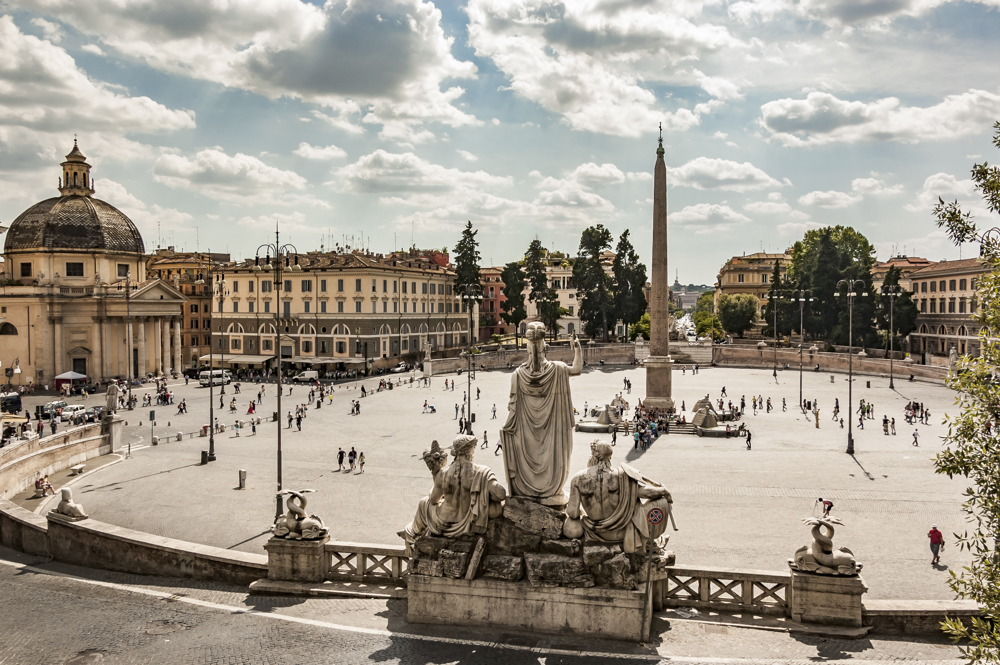
Executions were public spectacles held at prominent spots in Rome, such as the Piazza del Popolo.
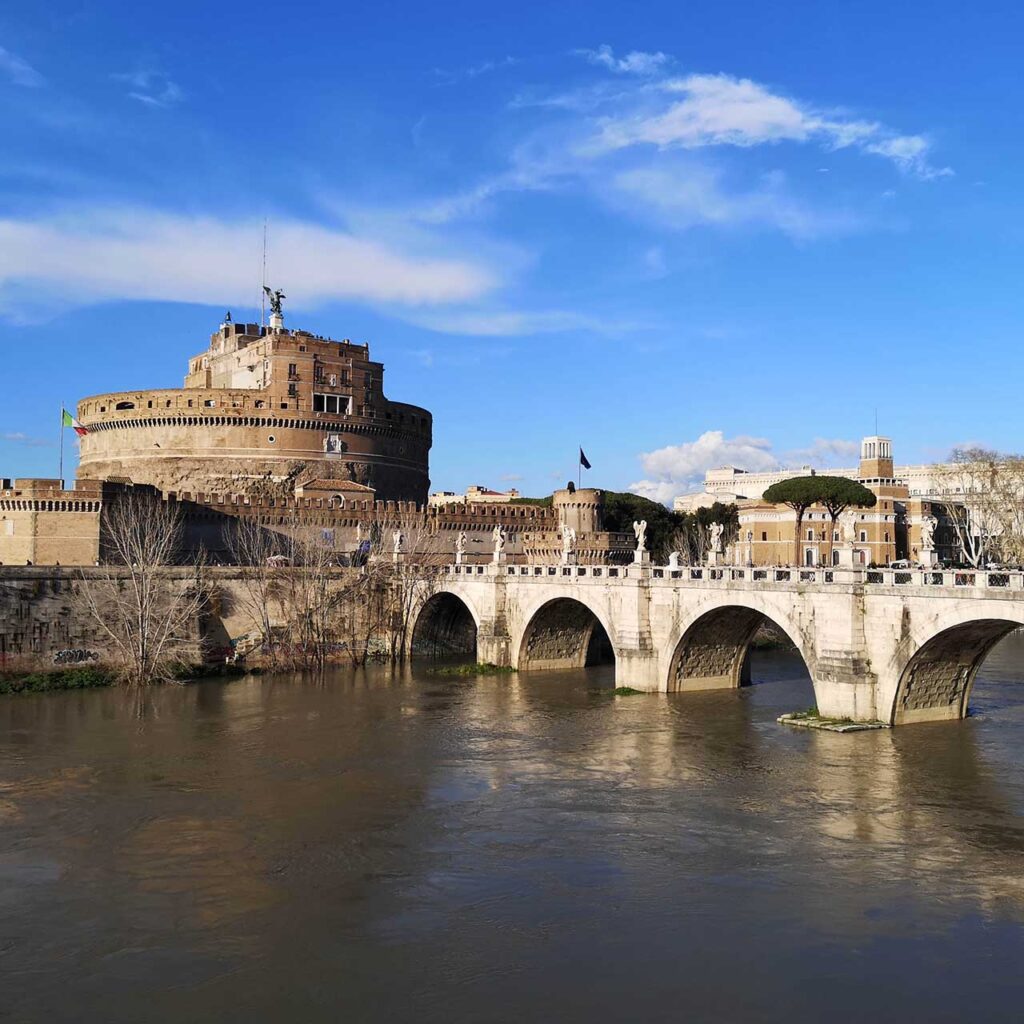
And most stunningly, the bridge at Castel Sant’Angelo.
Methods ranged from hanging and beheading with an axe to the mazzatello (striking the head with a heavy mallet before slitting the throat). After the French occupation of Rome in the early 1800s, the guillotine became the standard method.
The history of capital punishment at the Vatican is a striking story of contrast, spanning centuries where Popes ruled vast physical territories as temporal monarchs to the modern era where the death penalty was completely removed (by Pope Paul VI) from Church state law and doctrine.
For most of Catholic history prior to the late 19th century, the Holy See governed the Papal States, a large swath of central Italy. In these territories, Popes acted as secular rulers, and capital punishment was standard civil justice.
The most famous executioner?
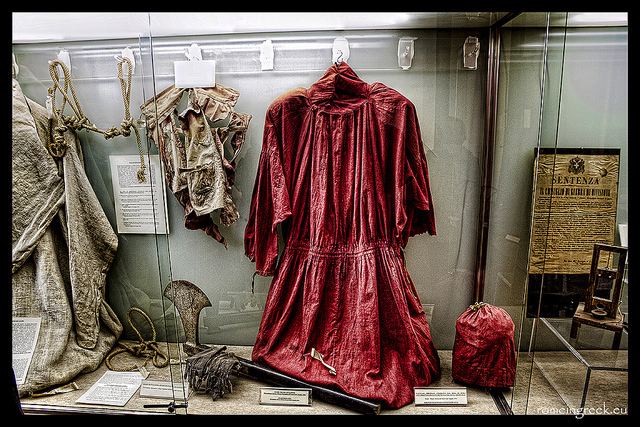
That was Giovanni Battista Bugatti, known popularly as Mastro Titta (“Master of Justice”) and his tools and garb looked like this:
Serving as the official papal executioner from 1796 until his retirement in 1864, Bugatti personally carried out 516 executions under the authority of several Popes. The final execution conducted under papal sovereignty took place in July 1870, just two months before Italian forces captured Rome and dissolved the Papal States.
In that span were Popes Pius VI, Pius VII, Leo XII, Pius VIII, Gregory XVI, and Pius IX.
Though technically still legal, by the time of Leo XIII, the practice of it had (whew) ended.
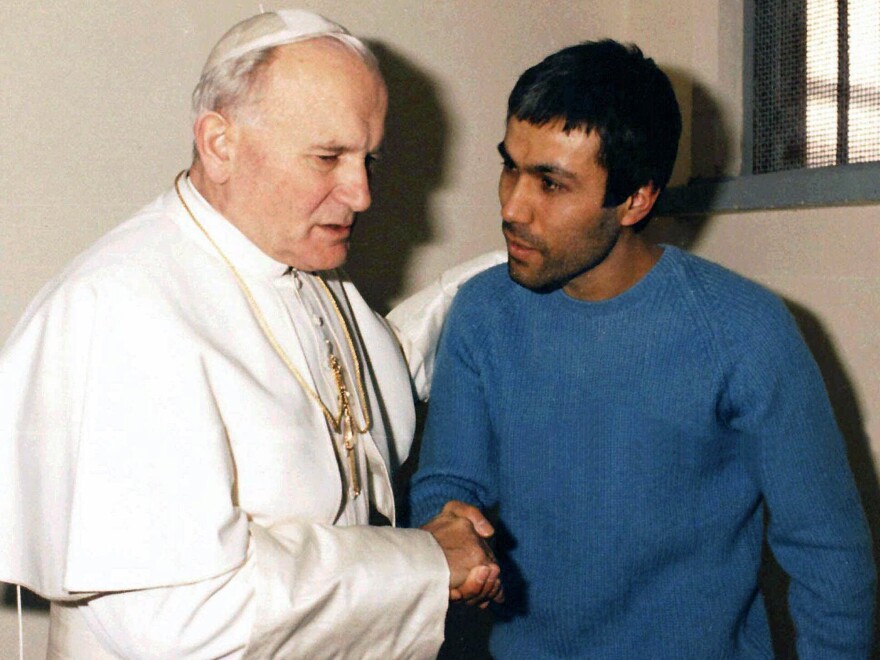
Quite a contrast with the way Saint Pope John Paul II treated his would-be assassin.
He sharply restricted moral justification for the death penalty in his 1995 encyclical Evangelium Vitae, and in 2018, Pope Francis updated the Catechism of the Catholic Church (Section 2267) to declare capital punishment strictly “inadmissible” in all cases, committing the Church to work toward its global abolition.
As for that executioner: the very sight of him approaching the bridge in his distinctive scarlet cloak sent shivers through that part of Rome.

Yet Bugatti was hardly a dark, mysterious figure living in a dungeon but a working-class Roman citizen. When he wasn’t carrying out sentences, he made a living as an umbrella seller and lived in the Borgo quarter near St. Peter’s Basilica with his wife.
Bugatti was known for his efficiency and his deeply pious demeanor. In accordance with the religious framing of papal justice at the time, executions were treated almost as solemn, liturgical acts of state authority.
Bugatti was famous for treating the condemned with gentle courtesy right before their death. He regularly offered them a pinch of snuff tobacco or a small glass of wine to steady their nerves. He went to Confession before every execution(!).
Such generosity!
Among those who witnessed the executions were writers Charles Dickens and Lord Byron, the latter paying on May 19, 1817, to stand in a position with a clear view as Mastro Titta executed three convicted robbers using the guillotine.
Writing to his publisher John Murray the same evening, Byron described the atmosphere as horrific and repulsive. He noted the stark, ritualized visual elements—priests wearing masks, the black crucifix held up to the condemned, half-clothed executioners, and the heavy thud of the blade followed by the spray of blood.
Byron recorded that the first two men died quietly, but the third fought bitterly, screaming in terror as Mastro Titta and his assistants forced him beneath the blade.
While Byron admitted to watching through opera glasses to capture every detail, he acknowledged in his letter that the experience left him physically shaken, deeply unsettled, and regretting having attended.
Bugatti carried out his final execution on August 17, 1864, at the age of 85. Pope Pius IX granted him an honorable retirement accompanied by a generous monthly papal pension. He was succeeded by his assistant, Vincenzo Balducci, who served until the Papal States fell to the newly unified Kingdom of Italy in 1870.
Bugatti died peacefully at home in 1869 at the age of 90.
Today, his blood-red cloak and execution equipment are preserved in the Museum of Criminology in Rome.
It’s a museum we’d prefer not to visit.
+