For decades, the greatest fear among epidemiologists when it comes to immediate, fast-moving, deadly bacteria or viruses has been ebola.
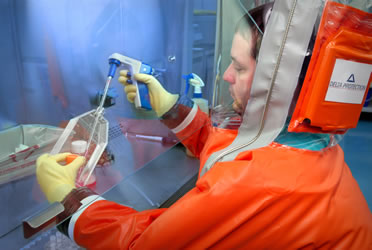
We recall a visit to the CDC to discuss this with officials who showed us the incredible, elaborately sealed labs where scientists were extracting various “bugs” and culturing them to test their characteristics.
Yes, less exotic viruses, like flu, were the most likely to cause a pandemic, they said (and were proved correct, as shown with COVID-19). But nothing is quite as draconian as the horrific bleed-outs of Ebola, which originates in Africa, kills in days and sometimes hours, and can cause bleeding from every orifice in the body.
Only the Blood of Christ is effective in stopping such a nemesis.
(Was God not famous in Scripture, and invoked repeatedly, to halt diseases that, excuse the cliché, plagued mankind? From Egypt to ancient Rome, the great tribulations most often involved disease along with warfare. We have both during our current time.)
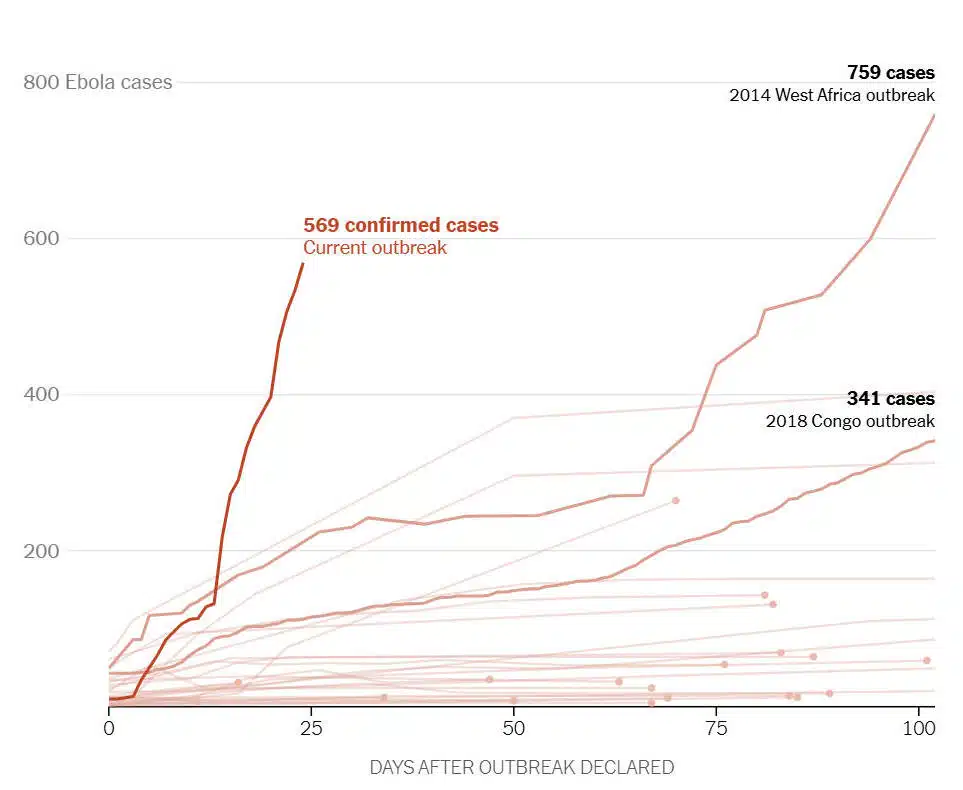
“In most Ebola outbreaks,” says The New York Times, “fewer than 500 people have been infected. The first few months are crucial to stop the spread. “Today, there are already over 569 confirmed cases, just 25 days since the latest outbreak was declared.”
Here’s a headline from this week:
This Could Be the Worst Ebola Outbreak in History
Truly widespread Ebola would make COVID-19 seem like a walk in the park, and would mandate even more precautions and isolation than did the 2019-2020 and 1918-1919 flu outbreaks. (In the 1918 one, which killed two Fatima visionaries, anyone in the U.S. without a mask was arrested.)
Pray it away. Pray also other rising threats such as screwworm in cattle.
“A fly that deposits its parasitic, flesh-eating offspring inside cows has been detected in Texas for the first time in decades, the U.S. Department of Agriculture (USDA) reported Wednesday (June 3),” says LiveScience. “A second case in a cow in the same county was announced June 5, and two more cases — in a cow and dog — in other Texas counties were flagged on June 8.”
As for infection with Ebola: Within days, that individual develops what feels like a standard tropical fever. But as the virus rapidly replicates, it systematically dismantles the immune system, hijacking white blood cells and using them to travel to every major organ.
The transformation from mild illness to severe disease is brutal. The virus attacks the lining of blood vessels, causing them to leak fluid. This triggers the classic, terrifying symptoms: intense fatigue, severe muscle aches, persistent vomiting, and explosive diarrhea. The term “hemorrhagic” comes into play as the body loses its ability to clot. Blood begins to seep from the gums, the nose, and needle injection sites.
[resources: Sent To Earth and Future Events]
The eyes turn a deep, ghostly red as tiny capillaries burst. Every fluid the body expels is heavily laden with millions of viral particles, turning the patient’s immediate environment into a biohazard zone. Because caregiving and traditional funeral practices involve close physical contact with these fluids, the virus quickly jumps to family members and healthcare workers, fanning out across a village or neighborhood.
It’s not to scare us. It’s to arm us with prayer-shields. As it said in Sent To Earth: “The prospect that millions would die from influenza or as a more exotic illness attacked the organs—causing massive convulsions and hemorrhage as have been glimpsed with ebola in Africa.
“A new plague, a mutated microbe, could begin there or in China or in the southern hinterlands of what had been the Soviet Union, perhaps from old leaking depots of germ warfare agents or in the West due to the transference of virus from animals cloned to provide human organs.
“It could come from wildlife, or farm animals, and with jet travel, reach anywhere in the world in less than a hundred hours. It could spread through the air or by touch or water or food, by sex. It could torment areas instantly, with a speed that would first amaze and then appall. It could be a strain never before seen that attacked like ebola but let the person live long enough to spread it. It could be a Frankenstein virus (as they called it at CDC), with new spikes of protein that eluded a cure or vaccination, that allowed it to rage through schools, through work, through the supermarkets, that allowed it to come to entire regions at once, to arrive in a major city by way of a single tourist or postman or businessman.
“It would be like a curtain dropping. Fever. Violent coughing. These were things that could occur on a global scale at any time and if it came with the same proportion as the Black Death, which had taken a third of those in Europe, the global numbers according to current demographics would be two billion.
“That was more than seven times the U.S. population and close to the combined populations of China and India and the sort of event that once again would cause people to pull their hair, to curse the lives they had lived without God. And it was possible; it was at the point of nearly probable. When the world became a staging area for hell, when it sought to destroy God’s plan, when it made the bold attempt to circumvent His rule — when there was coldness, haughtiness, and killing, when science sought to rule all — God broke it down.”
Prayer to St. Rocco, patron saint against epidemics and plagues
In the Name of the Father, and of the Son, and of the Holy Spirit.
Amen.
O Great St. Rocco, deliver us, we beseech thee, from contagious diseases.
Through thy intercession, preserve our bodies from illness, and our souls from the contagion of sin.
Obtain for us salubrious air, but, above all, purity of heart.
Assist us to make good use of health, to bear suffering with patience, and, after thy example, to live in the practice of penance and charity,
that we may one day enjoy the happiness which thou has merited by thy virtues.
(mention request here…)
St. Rocco, pray for us – 3 times.
In the Name of the Father, and of the Son, and of the Holy Spirit.
Amen.
[resources: Sent To Earth and Future Events]