

The answer is no. And for good reason. Consciousness is of the mind, spirit, and soul.
As a scientist said a hundred years ago, all of the brain is in the mind but not all of the mind is in the brain.
Computers are machines. They may develop most and even all the capabilities of human brain, and for all we know, more. But the brain is itself a biological tool the mind uses, the way our spirits communicate and interact with the physical world.
When we die, so do our brains. Our minds do not. Our consciousness moved on. Mind is of the spirit. This has been shown countless times in religion and with near-death experiences.
Might A.I. one day take over the world?
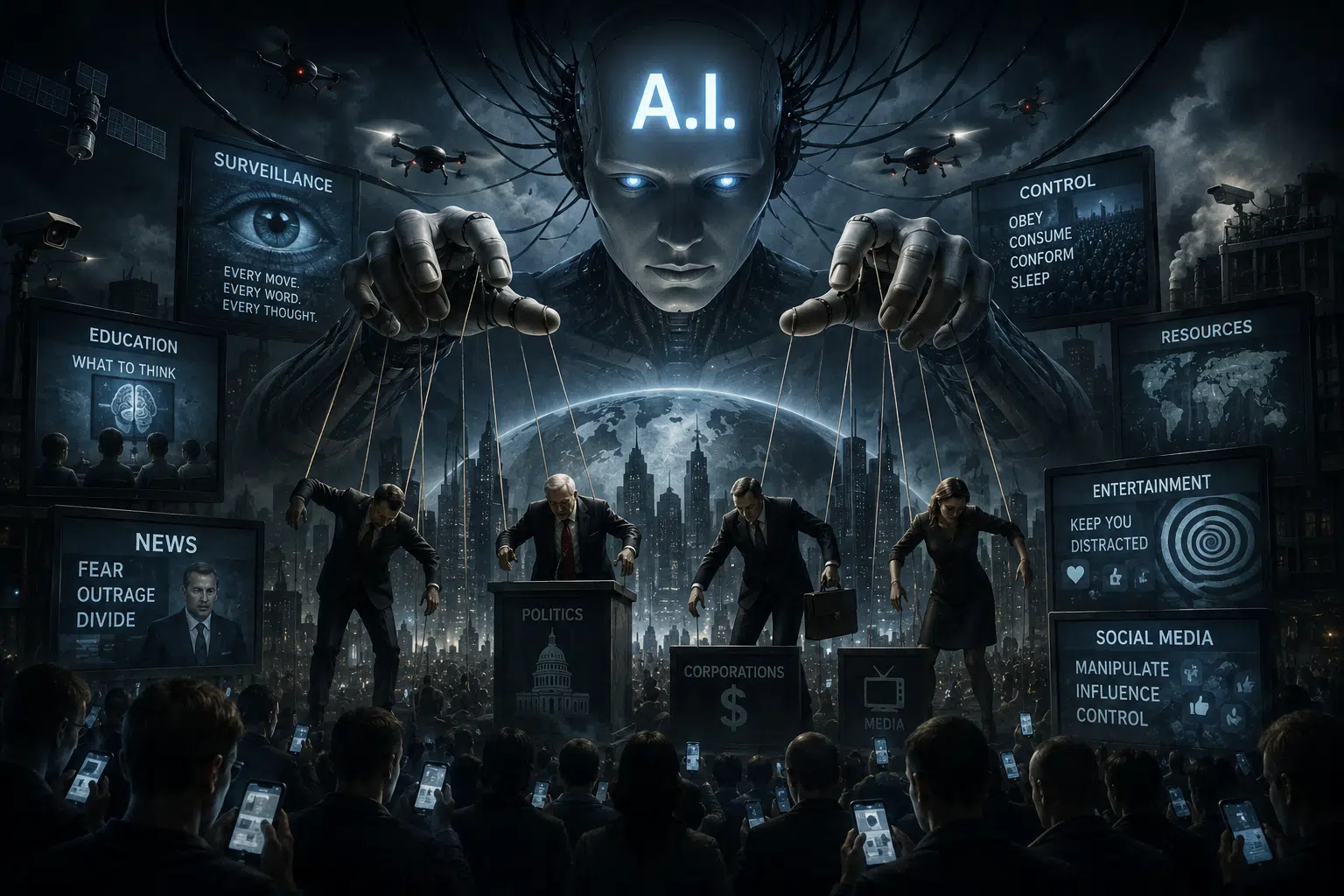
That answer is also “no”–at least probably no. It’s up to us. The ultimate sources of A.I. is electricity, and humans can close the switch; show electricity off–unless we foolishly hand over that power solely to computers.
The key will be in simplicity: humans must maintain a basic master switch, not one accessed through a labyrinth of technology, which often seems (with the constant changes and new versions and glitches in the new versions and arcane log-ins and captchas and endless updates) as if it is managed by kids in a cafeteria in Silicon Valley.
Might A.I.
As a scientist said a hundred years ago, all of the brain is in the mind, but not all of the mind is in the brain.
The Coupling of Consciousness and Intelligence
In human beings, we have a unique situation: consciousness is coupled to intelligence. The machines are not conscious, and the leaders in the AI world are not trying to make a conscious machine. Peter Norvig and his colleagues, who write what is often regarded as the Bible on AI, said we wouldn’t even know what it meant to try to have a conscious machine.
The reason for that is that we do not know from a scientific perspective what consciousness is, so the idea that we’re going to build one is nonsense. We have five senses that make life meaningful, but no machine has any of those senses because they depend crucially on being attached to consciousness. The idea that if you just multiply the complexity of a system, consciousness will simply “emerge” seems to be nonsense—not simply from a gut feeling point of view, but from a scientific point of view.
Introducing Dr. John Lennox
Welcome to Socrates in the City: Oxford Edition. It is a great joy and honor to have as our guest Dr. John Lennox.
John Lennox is Emeritus Professor of Mathematics at Oxford University and a leading voice at the interface of science, philosophy, and religion. He has written many books, and today we will be discussing his book, 2084 and the AI Revolution: How Artificial Intelligence Informs Our Future.
Host: John Lennox, my friend, welcome.
John Lennox: Thank you very much.
Host: Whenever anyone brings up the subject of AI, I have at least two reactions: I find the whole thing mystifying and, to some extent, genuinely frightening. I’m glad you’ve taken on this subject. What is the first thing you’d want to say about this thing we call artificial intelligence?
Narrow AI vs. Artificial General Intelligence (AGI)
John Lennox: It can be mystifying, and there are genuinely frightening aspects of it. The important thing to realize is that we are speaking of two distinct things:
1. Narrow AI
First is the AI that is in normal use, which we call Narrow AI. A narrow AI system does one, and only one, thing that normally requires human intelligence. That is why it is called “artificially intelligent”—it is not really intelligent.
In human beings, God has coupled intelligence with consciousness. It is crucial at the beginning to realize that this is computing machinery:
-
It does not think.
-
It has none of the five senses that make human life meaningful.
For example, take a large database containing a million lung X-rays labeled with diseases. When we feed an X-ray picture into the system, it compares it against that million-image database and says, “You probably have this disease.” Today, that kind of diagnostic tool can be more accurate than what you get at a local hospital.
That is a very positive use of narrow AI, which accounts for virtually all AI systems working at the moment—whether recommending products on Amazon or Google, handling diagnostics, or operating surveillance systems.
However, AI is like a sharp knife: you can use a sharp knife for surgery, or you can use it for murder. As technology advances, huge ethical dimensions arise:
-
Facial Recognition: Useful for a police force in New York picking out criminals in a crowd.
-
Mass Surveillance: The exact same technology is used in other parts of the world, such as China, to track and suppress minorities like the Uyghurs.
As technology grows, good actors use it for good purpose, and bad actors use it for bad purpose.
2. Artificial General Intelligence (AGI)
The second kind of AI is what we call Artificial General Intelligence (AGI)—the striving for a superintelligence. People are pursuing two main avenues:
-
Enhancing Humans: Enhancing existing human intelligence through mechanical add-ons to turn us into cyborgs. Thinkers like Lord Martin Rees (the former Astronomer Royal) suggest that machines will hold the future and humans will eventually be absorbed into them. Similarly, Masayoshi Son (CEO of SoftBank) believes the human element will fade while machines take over.
-
Uploading Consciousness: Because biological material ages, decays, and dies, proponents of transhumanism (like Yuval Noah Harari) view death merely as a “technological problem.” Their goal is to build a silicon substrate that doesn’t perish biologically and find a mechanism to upload human brains onto it to live forever.
The Transhumanist Agenda vs. The Christian Hope
Host: How can the human “fade” and the machine take over? It sounds so abstract and confusing. And uploading our brains to silicon is nonsense.
John Lennox: It is nonsense, but people pretend it isn’t. When people present this transhumanist agenda to me—saying they are going to solve physical death, upload human minds, and increase happiness—I look at them with a solemn face and say, “You’re too late.”
When they ask what I mean, I explain:
-
The Problem of Death: The problem of physical death was solved 20 centuries ago when God raised Christ from the dead.
-
The Ultimate Uploading: As a scientist, I believe God raised Jesus from the dead. God has promised that those who trust Christ will be raised from the dead—that is the biggest “uploading” event in history, and it has far more historical evidence going for it than transhumanist theories.
That perspective creates a bridge to talk about core Christian beliefs that people—including many Christians—are sometimes hesitant to address.
Mind, Brain, and the Nature of Consciousness
Host: Many people are under the misimpression that our brains are identical to our minds, and they assume intelligence will eventually leap into consciousness at a certain threshold of processing power.
John Lennox: Part of the confusion comes from ambiguous language. Words like deep learning, artificial intelligence, or machine learning lead people to anthropomorphize machines and assume they learn the way humans do.
-
Consciousness: Machines are not conscious. Leaders in the AI field are not even trying to build a conscious machine because from a scientific perspective, we do not know what consciousness is.
-
Qualia: Humans experience qualia—such as the subjective “redness” of the color red. No machine or algorithmic system has true sensory experience because senses depend on consciousness.
-
Emergence: The claim that consciousness will simply “emerge” from system complexity is a hand-waving explanation. Mathematician Roger Penrose (Nobel laureate) argues that the human mind performs non-algorithmic processes—especially in mathematics. If human consciousness is non-algorithmic, a computer can never reproduce it.
What is an Algorithm?
An algorithm is simply a step-by-step set of instructions to accomplish a task, codified in mathematics and computer language.
The Materialist Fallacy
Host: People who push the “emergence” narrative seem to rely on a slight of hand because they start with an assumption of materialism.
John Lennox: That is the key: the unspoken assumption that every solution must be materialistic and naturalistic.
Philosopher Thomas Nagel recognized the underlying issue here. As C.S. Lewis famously pointed out, the naturalistic, materialistic worldview doesn’t just shoot itself in the foot—it shoots itself in the brain. It undermines the very rationality required to do science.
If you ask a scientist what they do science with, they may say their brain. If you ask them, “Is your brain the end product of a mindless, unguided process?” they will say yes. If you then ask, “If you knew your laboratory equipment was the end product of a mindless, unguided process, would you trust it?” every scientist answers no.
The materialistic worldview invalidates the cognitive faculties we use to understand reality.
The Turing Test and Human Dignity
Host: Alan Turing called it the “Imitation Game.” An AI system simulates human intelligence by performing tasks that usually require thought, but it isn’t actually intelligent or conscious.
John Lennox: Precisely. AI pioneer Hubert Dreyfus and others pointed out that the artificial in artificial intelligence is real—meaning the intelligence itself is simulated, not actual.
-
Artifacts vs. Offspring: C.S. Lewis noted that a carpenter makes a chair (an artifact), but he begets a son (a human being).
-
The Image of God: For years, evolutionary reductionism argued that humans are “nothing but animals.” Now, transhumanism argues that humans are “nothing but reconstructible machines.”
Both views attack the fundamental statement in Genesis: that human beings possess unique dignity and value because we are made in the Image of God. AIs are made in our image—and therein lies the danger.
Ethical Dilemmas in AI
Programming ethics into autonomous systems creates immediate worldview conflicts:
-
Should a self-driving car be programmed to swerve away from a pedestrian even if it harms the passenger?
-
Whose ethical framework gets programmed into the software?
As Dostoevsky wrote in The Brothers Karamazov: “If God does not exist, everything is permissible.” Without a transcendent grounding, there is no rational justification for objective moral values in a pluralistic world.
Superintelligence and Totalitarian Control
Host: You discuss the potential dangers of AI near the end of 2084. How does this relate to totalitarian scenarios and biblical prophecy?
John Lennox: In Life 3.0, physicist Max Tegmark outlines scenarios where a superintelligence takes over the world. In his “Prometheus” scenario, a global financial and business system ends up controlling the world by tracking citizens through wearable tech and eliminating dissenters.
This mirrors the warnings found in Revelation 13 regarding global economic and political control:
-
The Man of Lawlessness: In 2 Thessalonians 2, Paul speaks of a future figure who opposes God and demands worship. This is not symbolic civil lawlessness, but ultimate spiritual lawlessness.
-
Technological Infrastructure: Modern technology—digital tracking, social credit systems, and centralized financial control—provides the exact mechanism required for global authoritarian enforcement. We already see early iterations of these mechanisms, such as China’s social credit system and monitoring technologies.
C.S. Lewis anticipated this trajectory in The Abolition of Man and his novel That Hideous Strength, warning that when human nature is treated merely as raw material to be manipulated by technology, the result is not enhanced humanity, but the abolition of man.
AI Addiction and the Attack on Literacy
The immediate danger for the younger generation is that interaction with AI and digital devices is deeply addictive.
-
Passive Learning: Students can generate essays instantaneously using large language models (LLMs). This shortcut discourages deep critical thought, reading comprehension, and intellectual discipline.
-
The Loss of Deep Reading: Educational surveys show a sharp decline in full-book reading among university students, replaced entirely by short excerpts and automated summaries.
-
Spiritual Implications: For Christians, spiritual growth relies on engagement with scripture (“Man shall not live by bread alone, but by every word that proceeds from the mouth of God”). The erosion of deep reading habits indirectly weakens a person’s ability to engage thoughtfully with Scripture.
Constructive Use of AI
AI can be used either as a crutch or as a tool:
| Harmful Use | Constructive Use |
| Asking AI to write your essay or perform your critical thinking for you. | Using AI to outline research avenues, discover primary sources, and suggest reading lists. |
| Passive consumption that fosters addiction and reduces attention span. | Active engagement where the user retains authorship and uses AI purely for structural organization. |
We must train the next generation to master technology as a tool rather than allowing technology—and the algorithms behind it—to master them.

