

Last Week (October 13) was an anniversary of the Fátima apparitions in Portugal and the day of the Great Sun Miracle.”
Recently also was the beatification of Archbishop Fulton Sheen, who saw three possible interpretations of the Miracle of the Sun, the third of who was “to regard it as a miniature and a cameo of what may yet happen to the world, namely, some sudden cataclysm or catastrophe … which would make the world shake in horror as the 70,000 shook at Fátima that day. This catastrophe would be a precocious or uncontrolled explosion of an atomic bomb which would literally shake the earth.”
There is irony in this, for the most extensive (if not in area largest) shrine dedicated to Fátima in North America sits immediately adjacent to what is known as the “Lake Ontario Ordnance Site” (or LOOW)—a sprawling, 7,500-acre military installation established during World War II in the Lewiston-Youngstown area of Niagara County, New York.

Initially used to manufacture TNT explosives, it became an important storage facility for radioactive materials associated with the Manhattan Project, which developed America’s first atomic bombs.
Beginning in 1944, thousands of tons of radioactive uranium-processing residues, uranium metal, and other atomic wastes were transported to the property.
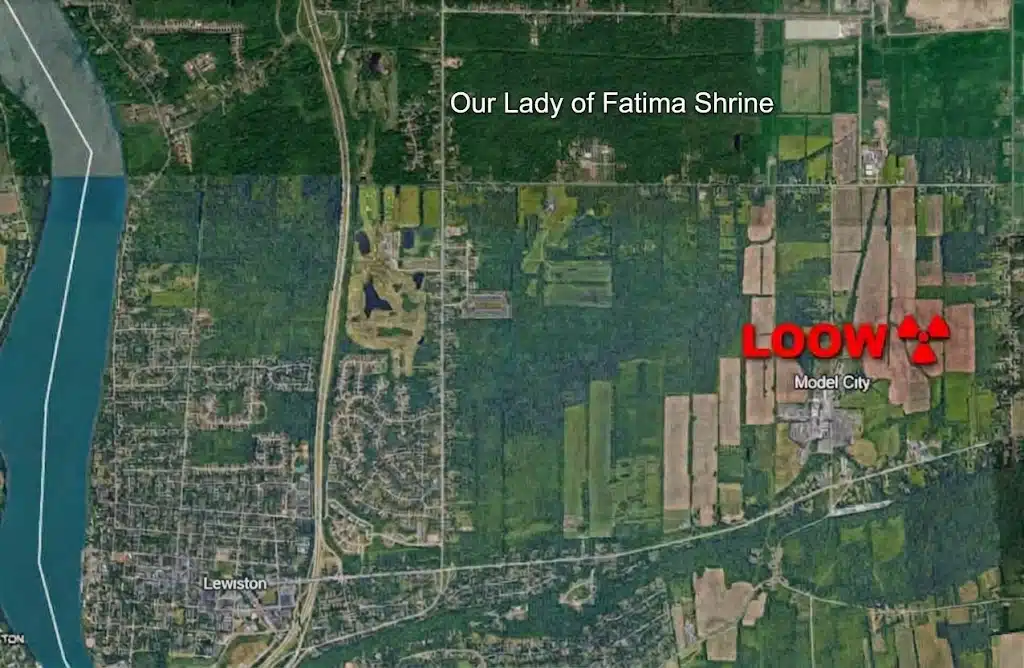
Today, a 191-acre portion is known as the Niagara Falls Storage Site, managed by the U.S. Army Corps of Engineers.
Parts of the original property were divvied up for road, residences, landfill dumps (including highly toxic chemicals), —and the shrine.
On that old federal land were 250,000 cubic yards of radiologically contaminated soil. Much has since been shipped to secure landfills in Texas and a cement silo that stored plutonium and spewed radon was dismantled. Before it was removed, the 16-story bin held large quantities of radium-bearing radioactive residues and presented genuine radiological hazards.
But contamination remains, including, astoundingly, at the shrine itself.
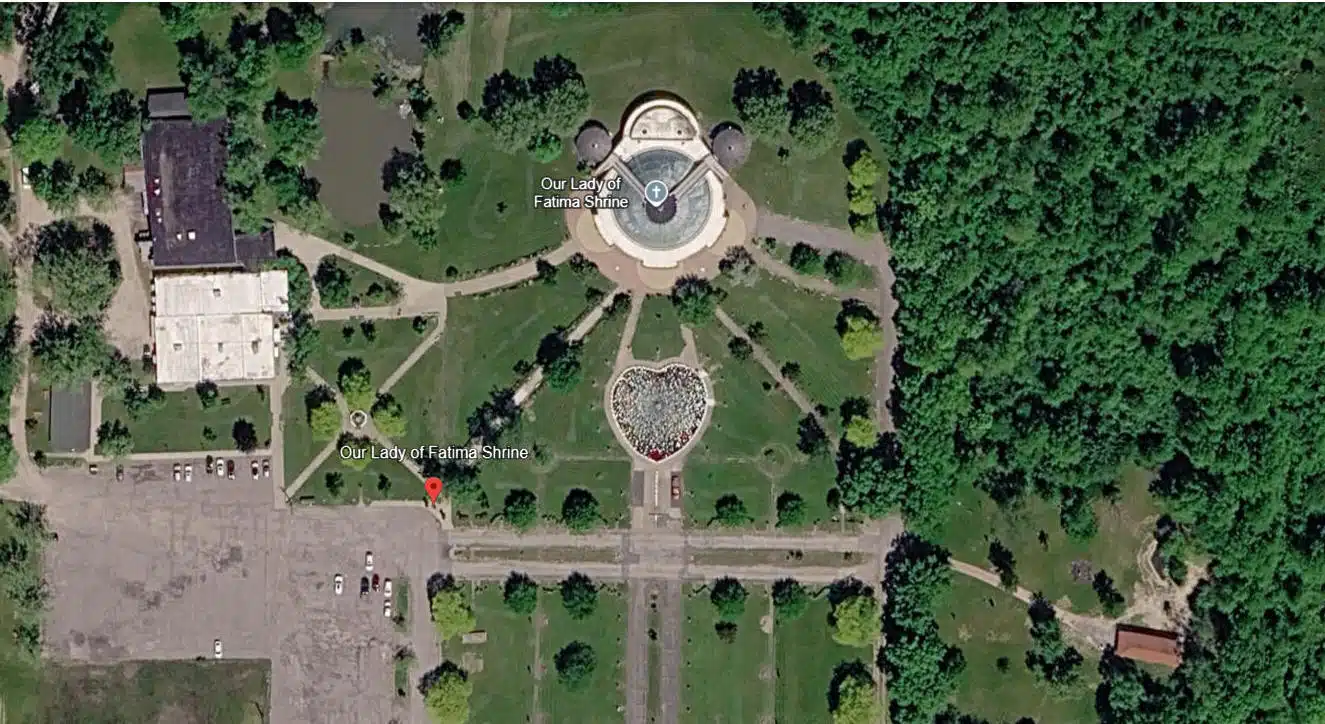
In 1978, an aerial radiation survey detected an unusually elevated radioactive signature over the shrine’s gravel parking lot.
A subsequent investigation by Oak Ridge National Laboratory identified substantial concentrations of radioactive elements in the crushed rock used to surface the parking area.
We’re talking Uranium-238 and Radium 226.
However, scientists believed the radioactive material originated not from the neighboring atomic storage facility but from industrial slag produced during the extraction of phosphorus from phosphate rock. A Niagara Falls industrial plant had used that process for decades.
A 2008 Community LOOW Project report concluded that the shrine’s contamination was not known to be connected with Manhattan Project operations.
But what an irony: A major Catholic pilgrimage shrine dedicated to Fatima had radioactive material in its parking-lot surface at concentrations dozens of times higher than natural background, within the same general area as one of the nation’s historic Manhattan Project waste-storage facilities.
Elevated radioactivity in a rock sample does not automatically mean visitors received dangerous radiation doses. That would depend on exposure levels, time spent nearby, and whether radioactive material was inhaled or ingested. The historical findings do not establish that the shrine grounds are unsafe today (if officials are to be trusted).
But again, an irony indeed.
Shrine mural:
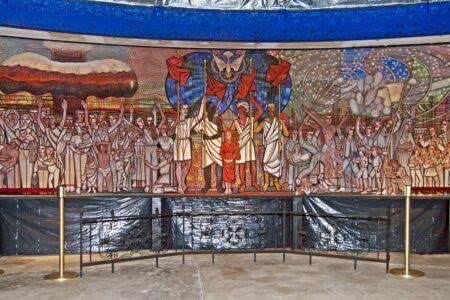
 Prophecies and Wisdom of St. Jacinta of Fatima
[Footnote and prayer need: Western New York was vital to the project to create the first atomic bombs, which were dropped on two Japanese cities during World War Two. Over 40 local companies contributed to the effort with some processing raw uranium ore under what would be considered dangerous conditions today.]